
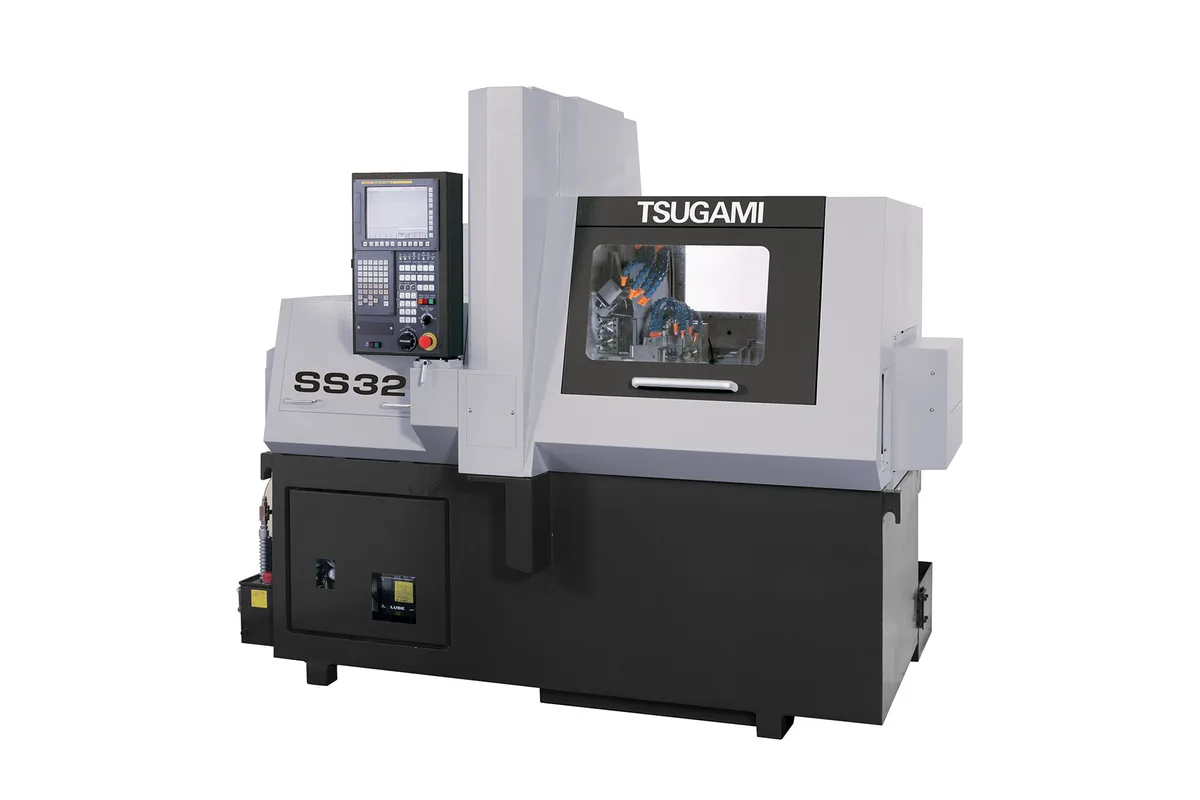
The Tsugami B0266 is an industrial-grade CNC Lathes & Turning Centers powered by the FANUC 32i-B. and a 3-axis kinematic layout. It supports standardized digital factory monitoring via MTConnect.
Tsugami B0266 6-axis Swiss-type lathe: 8 to 26 mm bar, rotary guide bushing with 320 mm stroke, 31/43 tools, 3.7/5.5 kW spindle, FANUC 32i-B.
| Standardized Parameters & Ratings | |
|---|---|
| Manufacturer (Brand) | Tsugami (International) |
| Machine Type | CNC Lathes & Turning Centers |
| CNC Controller System | FANUC 32i-B |
| Number of Controlled Axes | 3-Axis Simultaneous / Positioning |
| Spindle Taper Interface | Standard |
| Industrial IoT Protocol | MTConnect ANSI/MTC1.4 Compliant (Ethernet/TCP) |
| Catalogue Model | B0266-II (B0 Series catalogue, 6-axis) |
| Working Bar Diameter | φ8 to φ26 mm (0.31 to 1.02 in) |
| Max Machining Length | 320 mm (12.6 in) with direct-drive rotary guide bushing; 50 mm (1.97 in) guide-bush-less |
| Main Spindle Speed | 200 to 10,000 min-1 |
| Main Spindle Motor | 3.7 / 5.5 kW (5.0 / 7.4 hp) |
| Max Main Spindle Drilling | φ12 mm |
| Max Main Spindle Tapping | M10 |
| Rotary Guide Bushing Speed | 200 to 10,000 min-1 |
| Back Spindle Chucking Diameter | φ26 mm (1.02 in) |
| Back Spindle Speed | 200 to 10,000 min-1 (limited to 8,000 min-1 when the rotary tool beside the back spindle is mounted) |
| Back Spindle Motor | 2.2 / 3.7 kW (3.0 / 5.0 hp) |
| Max Back Spindle Drilling | φ10 mm |
| Max Back Spindle Tapping | M10 |
| Max Cross Drilling | φ8 mm |
| Max Cross Tapping | M6 |
| Max Slotting Cutter Diameter | φ45 mm |
| Max Back Drilling | φ8 mm |
| Max Back Tapping | M6 |
| Tool Spindle Speed | 200 to 6,000 min-1 |
| Tool Storage Capacity | 31 standard / 43 max. (option) |
| Turning Tool Size | 16 x 16 x 100 mm |
| Controlled Axes | 6-axis: X1, Z1, Y1, X2, Z2, Y2 plus C1, C2 |
| Rapid Traverse | 32 m/min (X1, Y1, Y2: 24 m/min) |
| Axis Motors | X1, Y2: 0.5 kW; Y1, Z1, X2, Z2: 0.75 kW |
| Cross Drill Motor | 1.0 kW |
| Coolant Pump | 0.4 kW |
| CNC Control | FANUC 32i-B |
| Least Input Increment | 0.001 mm (X1/X2 axis in diameter) |
| Tool Offset Pairs | 99 |
| Display | 10.4-inch colour LCD, Japanese/English |
| Part Program Storage | 64 kbyte (equivalent to 80 m tape for each path system), 63 registerable programs (sum of main and back spindle NCs) |
| Compressed Air Requirement | 0.4 MPa or above, 40 NL/min |
| Coolant Tank Capacity | 180 L |
| Dimensions Wxdxh | 2,150 x 1,280 x 1,930 mm (84.6 x 50.4 x 76.0 in) |
| Net Weight | 3,500 kg (7,716 lb) |
According to secondary market equipment benchmarks for November 2026, the Tsugami B0266 is estimated between $45,000 and $87,500 USD depending on machine hours, spindle condition, and tooling package. Financing and industrial lease options typically start around $698 / month.
The working bar diameter is 8 to 26 mm (0.31 to 1.02 in), and the back spindle chucks up to 26 mm (1.02 in), so a part can be transferred at full bar diameter. Turning tools are 16 x 16 x 100 mm.
It is driven directly and turns at 200 to 10,000 min-1, the same range as the main spindle, so the bar rotates with the bushing instead of spinning inside a fixed one. That is what allows 320 mm (12.6 in) of machining per chucking. Without the bushing the machine works guide-bush-less with 50 mm (1.97 in) of stroke.
They run from 200 to 6,000 min-1 on a 1.0 kW motor. The catalogue rates them for 8 mm cross drilling, M6 cross tapping and slotting cutters up to 45 mm in diameter; back drilling is rated to 8 mm and back tapping to M6. Larger features belong on the main or back spindle, which drill to 12 mm and 10 mm.
A 21.4 kVA power supply and compressed air at 0.4 MPa or above with 40 NL/min. The coolant tank holds 180 L and the pump is rated 0.4 kW. The machine measures 2,150 x 1,280 x 1,930 mm (84.6 x 50.4 x 76.0 in) and weighs 3,500 kg (7,716 lb), before any bar feeder.
A FANUC 32i-B with a 10.4-inch colour LCD in Japanese or English, 99 tool offset pairs and a least input increment of 0.001 mm. Program storage is 64 kbyte, with 63 registerable programs shared between the main and back spindle paths.

Peer engineering insights, spindle reliability feedback, and real-world shop floor experiences.