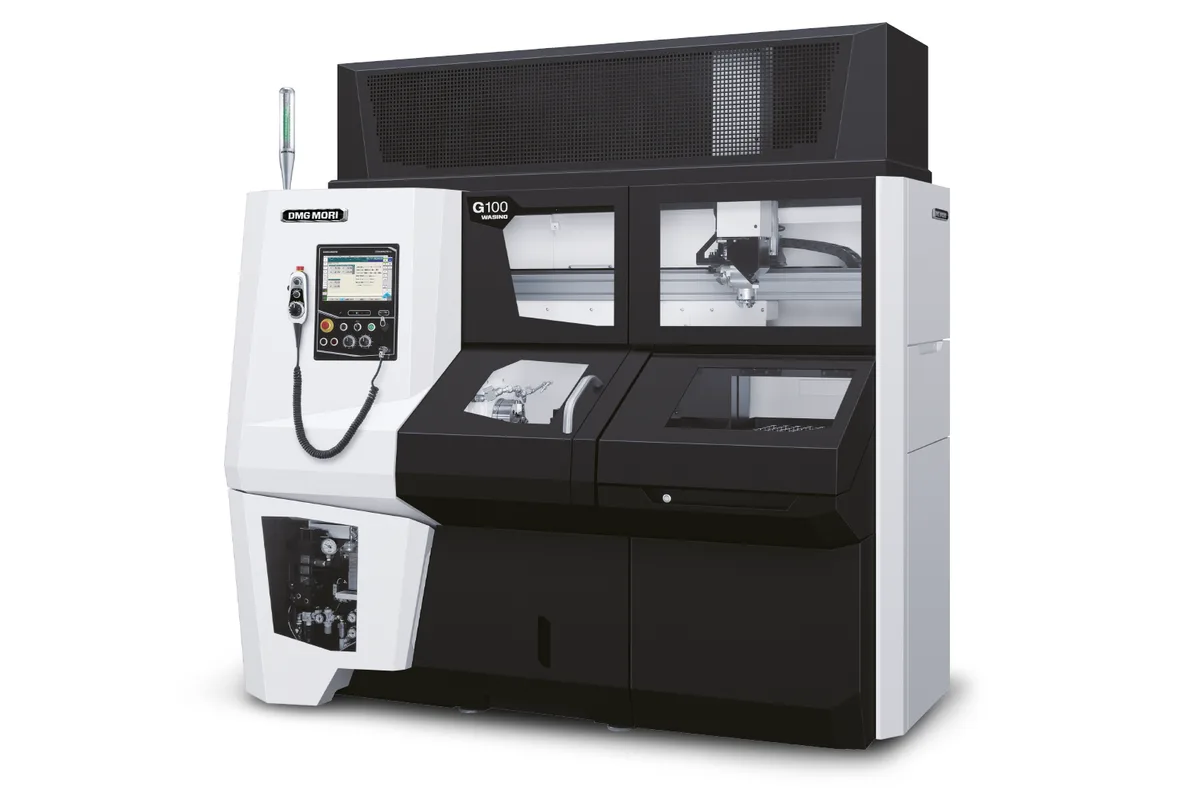
The DMG MORI Wasino G 100|480 is an industrial-grade CNC Lathes & Turning Centers powered by the Standard CNC. and a 3-axis kinematic layout. It supports standardized digital factory monitoring via MTConnect.
DMG MORI Wasino G 100|480: flat tooling turning center with 480 mm X and 285 mm Z travel, parts to 285 x 280 mm, 38 mm bar capacity.
| Standardized Parameters & Ratings | |
|---|---|
| Manufacturer (Brand) | DMG MORI (Germany / Japan) |
| Machine Type | CNC Lathes & Turning Centers |
| CNC Controller System | Standard CNC |
| Number of Controlled Axes | 3-Axis Simultaneous / Positioning |
| Spindle Taper Interface | Standard |
| Industrial IoT Protocol | MTConnect ANSI/MTC1.4 Compliant (Ethernet/TCP) |
| X-Axis Travel | 480 mm (18.9 in) |
| Z-Axis Travel | 285 mm (11.2 in) |
| Max Workpiece Diameter | 285 mm (11.2 in) |
| Max Workpiece Length | 280 mm (11 in) |
| Max Bar Capacity | 38 mm (1.5 in) |
| Bed Construction | Cast iron construction |
| Slideways | Induction-hardened horizontal slideways integrated on the bed |
According to secondary market equipment benchmarks for November 2026, the DMG MORI Wasino G 100|480 is estimated between $43,500 and $85,500 USD depending on machine hours, spindle condition, and tooling package. Financing and industrial lease options typically start around $674 / month.
480 mm (18.9 in), which matches the number after the bar in the model name. Z travel is 285 mm (11.2 in). Because flat tooling shares the X stroke between the tools in the row, the 480 mm is partly clearance for the part and partly tool capacity.
Up to 285 mm (11.2 in) in diameter and 280 mm (11 in) in length. The length limit sits just under the 285 mm (11.2 in) Z travel, so a part of that length leaves very little approach distance. In diameter there is more margin, since X travels 480 mm (18.9 in).
Only for small diameters. Bar capacity is 38 mm (1.5 in), against a maximum workpiece diameter of 285 mm (11.2 in). Parts above the bar size are chucked individually, and DMG MORI lists system variations and peripheral devices for adapting the machine to the production setup.
That it is a cast iron construction with a symmetrical structure with respect to the spindle center, on a rigid bed with a low center of gravity. The horizontal slideways are induction-hardened and integrated on the bed, and a pre-tension structure is adopted to suppress thermal displacement.
Peer engineering insights, spindle reliability feedback, and real-world shop floor experiences.